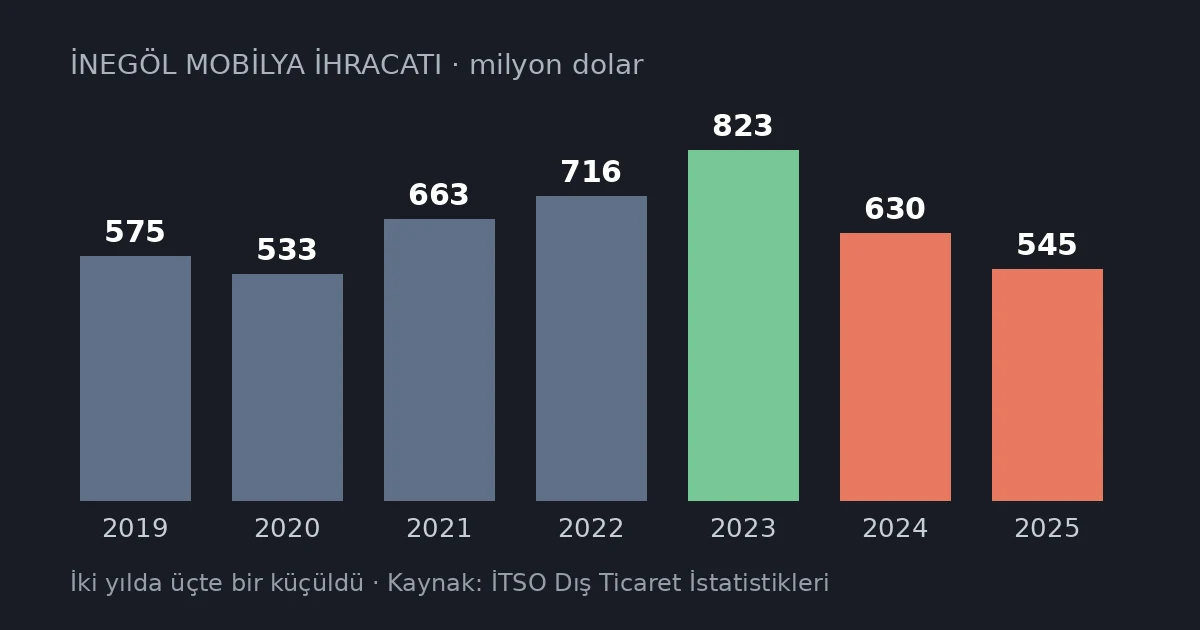
İnegöl's furniture exports shrank by a third in two years. Ask why, and the answer you hear most often is "the wars". I thought so too. Then I looked at the numbers, and the picture turned out different from what I expected.
The numbers first
Every year the İnegöl Chamber of Commerce and Industry publishes the district's foreign trade statistics. According to those publications, furniture exports were:
- 2019: 575 million dollars
- 2021: 663 million dollars
- 2023: 823 million dollars
- 2024: 630 million dollars
- 2025: 545 million dollars
That is a loss of 279 million dollars in two years, or 34 percent. The 2025 figure is below 2019. The number of furniture firms that export fell from 1,415 in 2024 to 1,016 in 2025; four hundred firms stopped exporting in a single year.
Why the war explanation falls short
Turkey's largest furniture market is Iraq. If wars had closed the market, we would see it there first. We do not: Turkey's furniture sales to Iraq rose 18.5 percent in 2024 and about 12 percent in 2025. İnegöl fell in those same two years.
So the market did not close. Iraqi buyers kept buying from Turkey, but bought less from İnegöl.
I am not saying war had no effect. Trade with Israel stopped in May 2024, and Libya and the Gulf weakened. In 2026 things did change: Iraq moved to a new customs regime at the start of the year, a war began in the region in February, and some exporters could not collect payment for goods that had crossed the border. For today, "the war" is a fair explanation. It does not explain the fall from 2023 to 2025.
The main cause: the cheap lira period ended
The Central Bank publishes an indicator called the real exchange rate. It measures the gap between price increases in Turkey and the increase in the dollar rate. If inflation is 40 percent and the currency moves 20 percent, goods made here become more expensive for the buyer abroad.
That indicator hit its low of 73 in July 2023. The 2025 average was 100, and it stood at 105 in September 2026. A sofa made in Turkey became roughly 45 percent more expensive for a foreign buyer in two to three years.
The comparison I find most striking is this: in 2019 the indicator was at today's level and İnegöl sold 575 million dollars. In 2025 it is at the same level again and İnegöl sells 545 million dollars. The 823 million peak in between was largely a gift of the period when the lira was very cheap. That period ended, and the figure went back to where it had been.
Labour tells the same story. The minimum wage was worth about 300 dollars in 2021; today it is around 650 dollars. In labour-intensive work such as sofas, upholstery and classic sets, that goes straight into the price.
What I hear in the trade completes the picture: importers can no longer sell what they buy from us at a workable price in their own countries. One buyer's remark, quoted by a sector representative, is blunter: "We are not obliged to import your inflation."
Why Turkey did not fall as much
Turkey's furniture exports rose 1.7 percent in dollar terms in 2025. But they fell 12 percent in volume. The country sold fewer goods at higher prices.
This is where the difference appears. Sellers who could raise prices and keep their customers held their ground. Sellers whose customers left when prices went up lost both volume and value.
You can see this in where İnegöl's decline is concentrated. Exports by firms inside the organised industrial zones fell about 13 percent in two years. Exports by firms outside those zones fell 40 percent. The large producers were shaken; the small exporters dropped out of the game.
There is also a rival in the same market. More than half of Iraq's furniture imports come from China. As the price gap widens, a producer who sells on price alone has nothing left to hold on to.
A caveat: two measurements do not count the same thing
To be honest, the numbers have a limit. According to the Turkish Exporters Assembly, Bursa province's exports of furniture, paper and forest products fell only 9 percent over the same two years. Kayseri declined by the same rate.
The gap between the two figures is large. One possibility is that part of what is produced in İnegöl is now exported in the name of trading companies registered in other cities. I found no data showing this; I note it as a possibility. Nor is it published how much İnegöl sells to which country. If those two pieces of information were made available, the picture would be much clearer.
What is certain is this: the total exported by firms in İnegöl under their own name shrank by a third, and the shrinkage was concentrated in small firms.
The same picture at home
The contraction in exports came together with the domestic market. According to the records of the İnegöl Chamber of Carpenters and Furniture Makers, 229 businesses closed and 209 opened in 2024. It is the first year in which closures exceeded openings. I wrote separately about how businesses change hands in the article on three years of change in the firm list.
Furniture production across Turkey did not fall in the same period. The contraction is not in the sector as a whole but in the segment that sells on price.
The "let the dollar float and exports will open up" view
Wherever I go in the trade I hear two sentences. One is "the wars"; the other is "if they let the dollar go, exports will open up". The second has a point, and the numbers in this article support it: the problem really is the exchange rate.
In October 2025 the head of an exporters' association said that a dollar at 50–55 lira instead of that day's 41 would give the sector a competitive advantage of about 30 percent. That is exactly what happened in 2021–2023: the lira was cheap and İnegöl set a record.
Why a weaker lira lifts sales
Let me use an example; the numbers are illustrative. Say a sofa set costs 60,000 lira to make. With the dollar at 30 lira, that set costs the buyer 2,000 dollars. If the dollar quickly rises to 40 lira, the same set is 1,500 dollars. The producer's cost in lira has not changed, but for the buyer abroad the goods are 25 percent cheaper.
Buyers look at price. If the set they bought yesterday from China or elsewhere can now be had more cheaply from İnegöl, the order comes here. The producer keeps part of the difference too; both sales and profit rise. That is what happened in 2021–2023.
Why the effect is temporary
Because the 60,000 lira cost does not stay put. Three things happen in sequence:
- Inputs go up within weeks. The chemicals in foam, the yarn in fabric, mechanisms and part of the board are bought in foreign currency or priced against it. When the currency weakens, their lira prices rise.
- Wages follow within a year. The weaker currency feeds into shop prices, inflation rises, and wages rise with it. The minimum wage going from about 300 to 650 dollars is the result of this process.
- The buyer wants a share. Buyers see the currency move too and ask for a lower price. Part of the advantage goes in negotiation.
A year or two later the same set costs 80,000 lira to make. If the dollar is still at 40 lira, the set is 2,000 dollars again. We are back where we started; only the numbers are bigger.
The real exchange rate measures exactly this, and it shows what happened: it fell to 73 in 2023, meaning the goods became very cheap, and rose back to 100 in 2025, meaning the advantage was fully reversed. Exports followed the same path.
Sales that came with the currency advantage left when the advantage ended. No lasting market, brand or loyal customer remained.
If the currency weakens, sales will come back; I agree with that. But a firm with nothing to set it apart will end up in the same place at the next turn. A weaker currency buys breathing room; what we do with that room decides the outcome.
What follows from this
Anyone who blames the decline on war expects things to recover when the war ends. The numbers do not support that expectation. The sales of 2023 were not lasting growth; they were a currency advantage, and there is no visible reason for it to return.
Looking at those still standing, I see two groups. The first has something that lets it raise prices: a brand, design, contract work or a direct relationship with the customer. The second can carry its costs through scale.
İnegöl's strength in design and models today bears no comparison with a few years ago. The problem is no longer the product. The problem is the lack of what makes that product bought because it is good rather than because it is cheap: a brand and a relationship with the customer. That is what will make the difference in the period ahead.
Sources
- İnegöl Chamber of Commerce and Industry, İnegöl Foreign Trade Statistics 2025 and the same publication for earlier years
- İnegöl Chamber of Commerce and Industry, İnegöl Economy Report 2025
- Turkish Exporters Assembly, sector figures by province (2023 and 2025)
- İstanbul Furniture, Paper and Forest Products Exporters' Association, December 2025 export review
- Central Bank of the Republic of Türkiye, CPI-based real effective exchange rate
- Ministry of Trade, Iraq Furniture Sector Market Research Report